You know what the biggest all-consuming concern of the PR industry today should be? It's trust.
Americans don't trust anyone (or hardly anyone as it were).
In a recent Gallup poll it turns out that across 16 core elements of "civil society", a majority of Americans only trust three things: the military, small business and the police.

A majority of American's do not trust (or have confidence in) the President, the news, big businesses, and only 10 per cent have confidence in their elected representatives (ie. Congress).
It is very clear that for the next two decades PR's #1 task is going to be about reestablishing (or in some cases maintaining) trust with the general public.
The fact that only 25 per cent of the population has confidence in newspapers is staggering. It's not only staggering in terms of what it means for PR professionals (one has to ask, is PR making things worse?) but for society as a whole. When people feel they can no longer trust the 'news' then what gives them a sense of connection and belonging to society as a whole?
If most of the organizations on this list cannot reestablish trust with the public it spells dark times ahead for everyone.
Americans don't trust anyone (or hardly anyone as it were).
In a recent Gallup poll it turns out that across 16 core elements of "civil society", a majority of Americans only trust three things: the military, small business and the police.
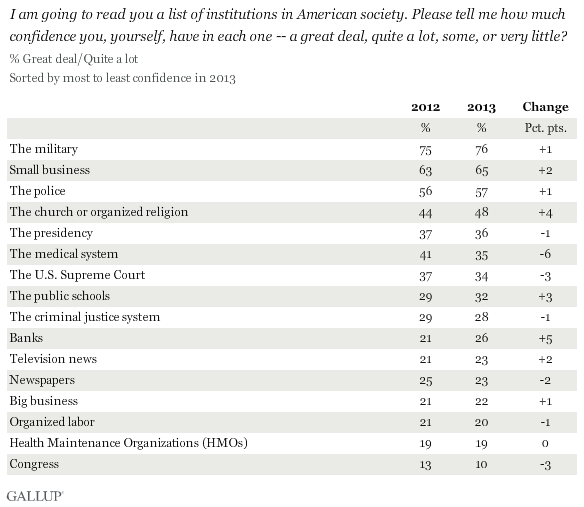
A majority of American's do not trust (or have confidence in) the President, the news, big businesses, and only 10 per cent have confidence in their elected representatives (ie. Congress).
It is very clear that for the next two decades PR's #1 task is going to be about reestablishing (or in some cases maintaining) trust with the general public.
The fact that only 25 per cent of the population has confidence in newspapers is staggering. It's not only staggering in terms of what it means for PR professionals (one has to ask, is PR making things worse?) but for society as a whole. When people feel they can no longer trust the 'news' then what gives them a sense of connection and belonging to society as a whole?
If most of the organizations on this list cannot reestablish trust with the public it spells dark times ahead for everyone.
Comments
Post a Comment